Start here
Force and motion
Connect position, speed, velocity, acceleration, net force, mass, inertia, and Newton's laws of motion.
Read lessonSubject Curriculum & Practice
Connect everyday observations with accurate scientific ideas about motion, energy, matter, cells, body systems, plants, and ecosystems.
10 structured lessons 10 topic assessments
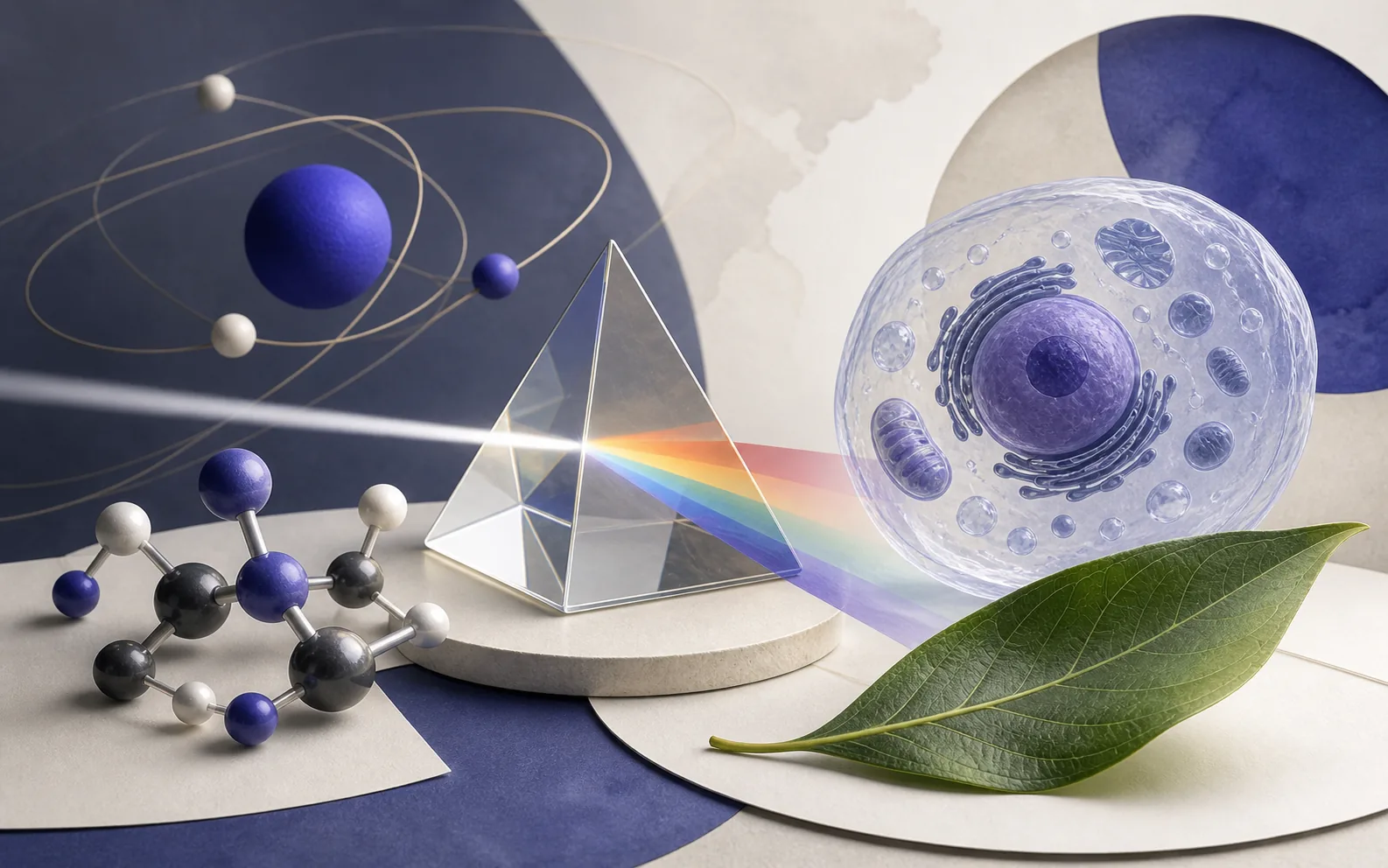
The General Science curriculum is organized systematically from baseline conceptual definitions to advanced practical applications. For optimal learning retention:
Read each lesson thoroughly, focusing on key definitions, worked demonstrations, and highlighted common mistakes.
Immediately complete the paired topic quiz to test your active recall and diagnose misconceptions using instant feedback.
Follow the recommended sequence below before tackling specialized topics or related subject intersections.
Start here
Begin with these foundational topics to establish core mental models, then continue through the remaining curriculum.
Start here
Connect position, speed, velocity, acceleration, net force, mass, inertia, and Newton's laws of motion.
Read lessonLesson
Understand mechanical work, kinetic and potential energy, power, and energy transformations.
Read lessonLesson
Master temperature, thermal transfer mechanisms, wave optics, electric potential, current, resistance, and circuit configurations.
Read lessonLesson
Connect states of matter with particles and distinguish atoms, elements, molecules, and compounds.
Read lessonLesson
Distinguish pure substances and mixtures, then understand basic acid-base behavior and pH.
Read lessonLesson
Understand cells as the basic units of life and connect organelles, tissues, organs, and systems.
Read lessonLesson
Connect nutrients, digestion, circulation, respiration, excretion, and coordinated body function.
Read lessonLesson
Understand how plants capture light energy, exchange gases, transport materials, and grow.
Read lessonLesson
Connect organisms, energy flow, biogeochemical cycles, population dynamics, trophic cascades, and environmental resilience.
Read lessonLesson
Connect vibrations with sound waves, frequency, pitch, amplitude, intensity, reflection, speed, and hearing safety.
Read lessonTopic Assessments
General Science · Force and motion
Apply foundational ideas about net force, acceleration, work, energy, heat transfer, light, and circuits.
General Science · Matter, atoms, and molecules
Distinguish atoms, molecules, elements, compounds, mixtures, physical changes, acids, bases, and pH.
General Science · Cells and the organization of life
Review cell structures, body-system relationships, photosynthesis, respiration, food webs, and matter cycles.
General Science · Ecosystems and the environment
Check ecosystem components, energy flow, matter cycles, populations, limiting factors, food chains, biodiversity, and resilience.
General Science · Elements, compounds, acids, and bases
Distinguish elements, compounds, mixtures, physical separation, acid-base behavior, and the logarithmic pH scale.
General Science · Heat, light, and electricity
Check temperature, heat transfer, conduction, convection, radiation, light behavior, circuits, current, and voltage.
General Science · Nutrition and human body systems
Connect nutrients, digestion, absorption, respiration, circulation, excretion, and coordinated body-system function.
General Science · Plants and photosynthesis
Check photosynthesis, chlorophyll, chloroplasts, stomata, water transport, respiration, and plant roles in ecosystems.
General Science · Work and energy
Apply mechanical work, kinetic and potential energy, power, energy transfer, transformation, and conservation.
General Science · Sound and waves
Check vibrations, mechanical waves, frequency, pitch, amplitude, intensity, speed, reflection, and hearing safety.